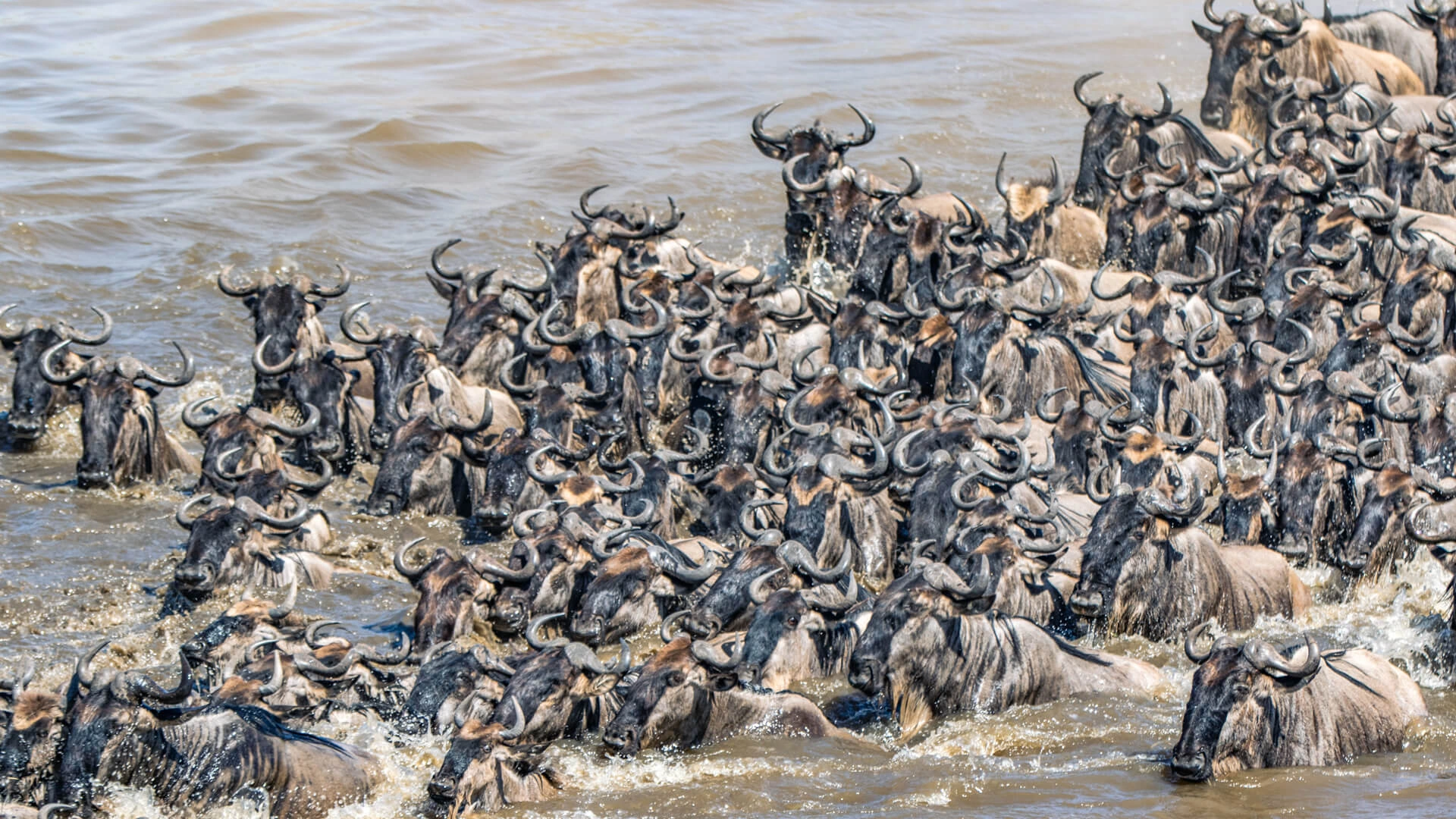
The Great Wildebeest Migration is not a single, isolated event. It is a continuous, cyclical journey driven entirely by rainfall patterns, grazing conditions, and ancient instincts. Over two million wildebeest, zebras, and gazelles travel a relentless loop through the broader Serengeti-Mara ecosystem in search of green pasture.
Because the herds are constantly moving, planning a migration safari requires precise timing and alignment with local camp logistics. There is no single "best time" to visit, but rather a set of distinct seasonal phases that offer vastly different wildlife experiences.
The Month-by-Month Migration Movement
To accurately map your journey, our Arusha operational team has compiled the baseline movement matrix used to select accommodations throughout the 2026 and 2027 seasons.
| Months | Ecosystem Location | Core Wildlife Event |
|---|---|---|
| Jan — Mar | Southern Serengeti & Ndutu Plains | Calving Season & Dense Predator Actions |
| Apr — May | Western Corridor & Central Plains | The Rutting Period & Green Savanna Movement |
| Jun — Jul | Grumeti River to Northern Serengeti | Early River Crossings & Northward Trekking |
| Aug — Oct | Northern Serengeti (Mara River) | Dramatic Mara River Crossings |
| Nov — Dec | Lobo Corridor toward Southern Plains | Southward Migration Journey Following Rains |
Key Seasonal Pillars: What to Expect
The Calving Season (January – March)
During this window, the herds settle onto the rich, nutrient-dense short-grass plains of Southern Serengeti and the Ndutu area. Over a brief 2-to-3 week period, roughly 500,000 wildebeest calves are born. This explosion of life draws unparalleled numbers of apex predators—lions, cheetahs, leopards, and hyenas—triggering fast-paced, dramatic hunting sequences across the open terrain.
Operational Reality Check
While calving is highly concentrated in January and February, this region becomes dry by late March. Booking camps with high regional fluidity or tracking mobile configurations is essential to guarantee proximity to the primary aggregations.
The Dramatic Mara River Crossings (July – October)
This is arguably the most famous chapter of the migration cycle. Facing drying plains, the herds press northward until they hit the barrier of the Mara River. To continue their search for grass, they must plunge across treacherous, crocodile-infested waters.
Witnessing a crossing demands immense patience; herds can gather on the banks for hours, testing the waters before a single brave individual initiates a chaotic, high-energy surge across the channel. This phase is best executed via dedicated accommodations in the Northern Serengeti, such as our featured listings in the Kogatende sector.
How Z&K Optimizes Your Migration Safari
Because these animals follow their own clock rather than our human calendar, template itineraries often miss the target. At Z&K Tanzania Safaris, we utilize live network feedback from our active driver-guides on the ground to modify routes or swap out luxury tented camps as wildlife distribution shifts.
Whether your goal is a private luxury migration pursuit or joining a shared dynamic tour, proper configuration is the ultimate factor that decides your overall safari success.